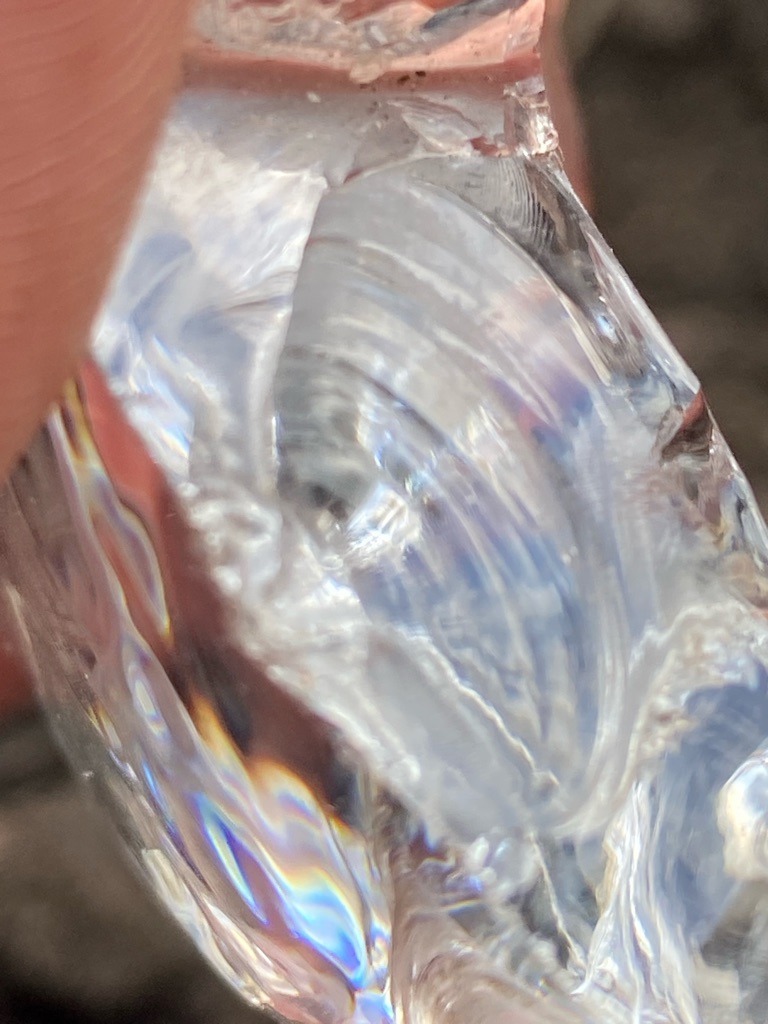
Not a diamond (appears to be optical glass or quartz showing distinct conchoidal fracture)
Not a diamond (appears to be optical glass or quartz showing distinct conchoidal fracture) · Irregular / Raw fragment
Not Applicable (Uncut/Raw or broken glass) Cut
Carat
Cannot accurately determine from visual alone, estimated heavy fragment
Color
Colorless / Transparent
Clarity
Included / Heavily fractured
Shape
Irregular / Raw fragment
Overall Assessment
Visual analysis clearly indicates this specimen is not a diamond. The curved ripple marks (conchoidal fractures) strongly point toward glass or quartz rather than the crystal cleavage planes found in genuine diamonds.
Cut Quality
Not Applicable (Uncut/Raw or broken glass)
Brilliance
Low due to lack of proper faceting
Fire
Displays some dispersion due to prismatic edge effects, but characteristic of glass rather than diamond
Scintillation
Poor
Proportions
Not applicable
Symmetry
Asymmetrical
Polish
Rough / Unpolished
Fluorescence
Not applicable
Inclusions
Conchoidal fracture lines, internal stress ripples
Blemishes
Surface chips and conchoidal fracture ripples
Origin
Synthetic glass or natural quartz crystal
Treatment Detection
None applicable
Estimated Value
Nominal / Low (Ornamental glass or quartz value only)
Certification Estimate
Will not receive certification from major gemological labs like GIA or AGS as a diamond
Investment Potential
None
Similar Diamonds
None (this is not a diamond)
Setting Suggestions
Not recommended for fine jewelry settings due to fragile nature and lack of gemstone status
Care & Maintenance
Handle with care to avoid chipping sharp edges
Interesting Facts
The prominent curved lines visible in the stone are conchoidal fractures, which are characteristic of amorphous materials like glass or cryptocrystalline quartz