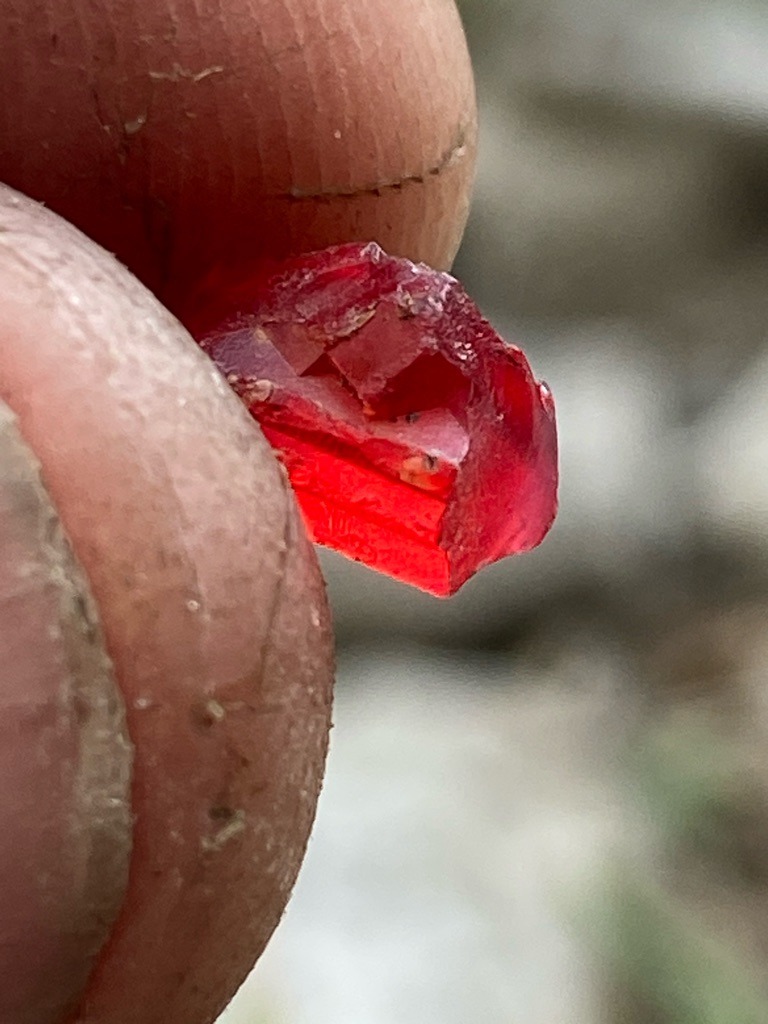
Not a diamond (appears to be a natural rough gemstone, likely red spinel, ruby, or tourmaline, as red natural diamonds are exceedingly rare and this specimen shows crystal habit typical of corundum or spinel)
Not a diamond (appears to be a natural rough gemstone, likely red spinel, ruby, or tourmaline, as red natural diamonds are exceedingly rare and this specimen shows crystal habit typical of corundum or spinel) · Rough crystal / Uncut natural crystal habit
Not applicable (Rough, unpolished crystal) Cut
Carat
Estimated 0.50 to 1.00 carats based on visual scale against fingers
Color
Natural Fancy Vivid Red
Clarity
Included (I1 equivalent for colored stones due to visible internal inclusions and fractures)
Shape
Rough crystal / Uncut natural crystal habit
Overall Assessment
An intriguing and vibrant red rough crystal. While highly likely to be a colored gemstone such as ruby or spinel rather than a diamond given the crystal habit and color saturation, professional gemological testing (Raman spectroscopy, FTIR) is necessary for definitive identification.
Cut Quality
Not applicable (Rough, unpolished crystal)
Brilliance
Moderate to low due to rough surface and raw state
Fire
Low in current rough state, depends on final cut
Scintillation
Minimal due to lack of faceted surfaces
Proportions
Not applicable to rough crystals
Symmetry
Natural crystal symmetry showing hexagonal or isometric growth remnants
Polish
Raw, unpolished crystal faces
Fluorescence
Cannot determine precisely without UV testing, likely inert to moderate
Inclusions
Internal feather fractures, crystal needles, and minor solid inclusions visible
Blemishes
Natural surface etch marks, rough patches, and minor abrasions
Origin
Alluvial or primary pegmatite/marble deposit depending on exact mineral species
Treatment Detection
No obvious signs of treatment; appears completely natural rough
Estimated Value
Varies widely depending on true mineral identity (e.g., if ruby, potentially $100 - $500 as rough; if red diamond, value would be astronomical, but highly improbable)
Certification Estimate
Would require GIA or SSEF colored stone report rather than diamond dossier
Investment Potential
High if confirmed as a rare natural fancy red diamond, moderate to low if standard colored gemstone (ruby/spinel)
Similar Diamonds
Red diamonds are among the rarest in the world; comparable rough usually benchmarked against high-end colored gemstones like Burmese rubies
Setting Suggestions
Custom organic bezel or prong setting to protect the raw crystal structure if worn as-is, or cut into a cushion/oval shape
Care & Maintenance
Avoid harsh ultrasonic cleaners until mineral identity is confirmed; store separately to prevent scratching other stones
Interesting Facts
Natural red diamonds owe their color to plastic deformation of the crystal lattice rather than chemical impurities