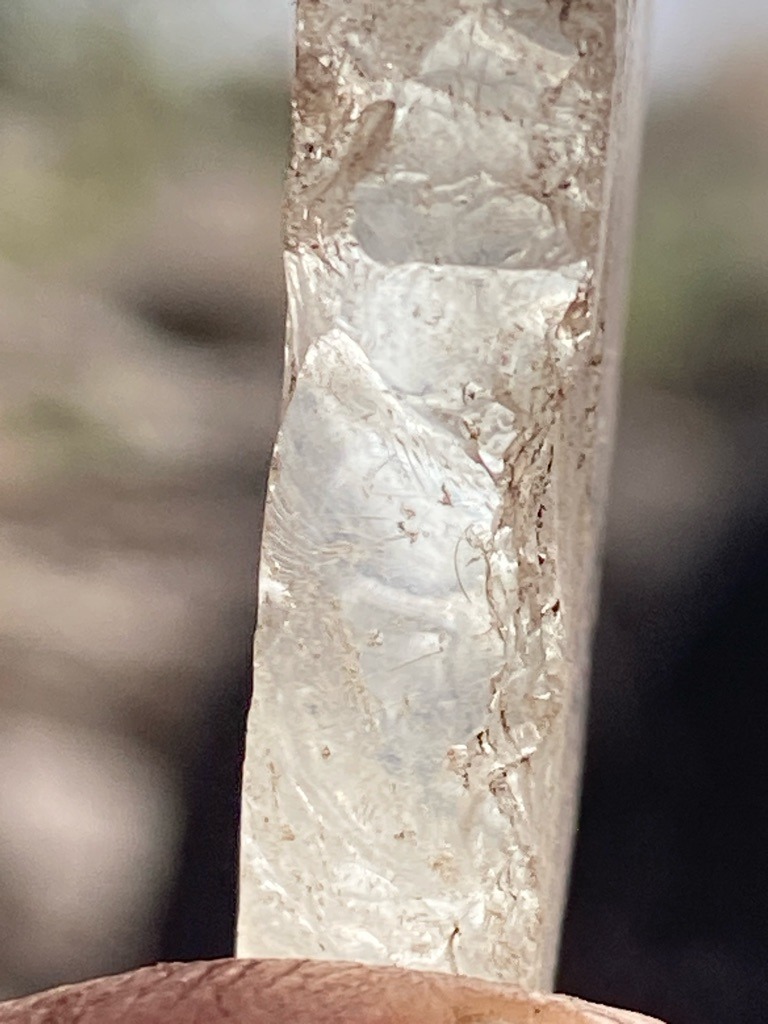
Natural rough diamond specimen
Natural rough diamond specimen · Uncut crystal / Rough matrix piece
Not applicable (Rough, unpolished stone) Cut
Carat
Estimated 2.5 to 3.5 carats
Color
Near-colorless with slight brownish or greyish undertones
Clarity
Included (I1-I3 equivalent for rough)
Shape
Uncut crystal / Rough matrix piece
Overall Assessment
An interesting raw diamond crystal specimen showing characteristic natural surface features and inclusions, ideal for mineral collectors or custom organic jewelry rather than traditional faceted applications
Cut Quality
Not applicable (Rough, unpolished stone)
Brilliance
Low due to lack of faceting and rough surface texture
Fire
Minimal to none due to lack of precision cuts
Scintillation
Absent due to uncut nature
Proportions
Natural rough dimensions, irregular slab-like crystal form
Symmetry
Natural asymmetric crystal formation
Polish
Unpolished, natural crystal surface showing growth lines and etch channels
Fluorescence
Indeterminate from visual assessment
Inclusions
Heavy internal feather fractures, pinpoints, and cloudy areas typical of untreated rough
Blemishes
Natural surface trigons, etch marks, rough edges, and surface irregularities
Origin
Likely alluvial or primary kimberlite deposit origin
Treatment Detection
No evidence of artificial treatments; entirely natural raw stone
Estimated Value
Modest collector or industrial/specimen value, highly dependent on internal sawing potential
Certification Estimate
GIA or similar major gemological lab could issue a rough diamond report
Investment Potential
Low investment value for jewelry, primarily valued as a mineral specimen
Similar Diamonds
Comparable to standard industrial-grade or low-clarity gem-grade rough parcels
Setting Suggestions
Best kept as a raw specimen or custom-designed wire-wrap organic setting
Care & Maintenance
Store securely away from harder minerals to avoid chipping along cleavage planes
Interesting Facts
Displays natural growth textures and cleavage patterns formed deep within the Earth's mantle