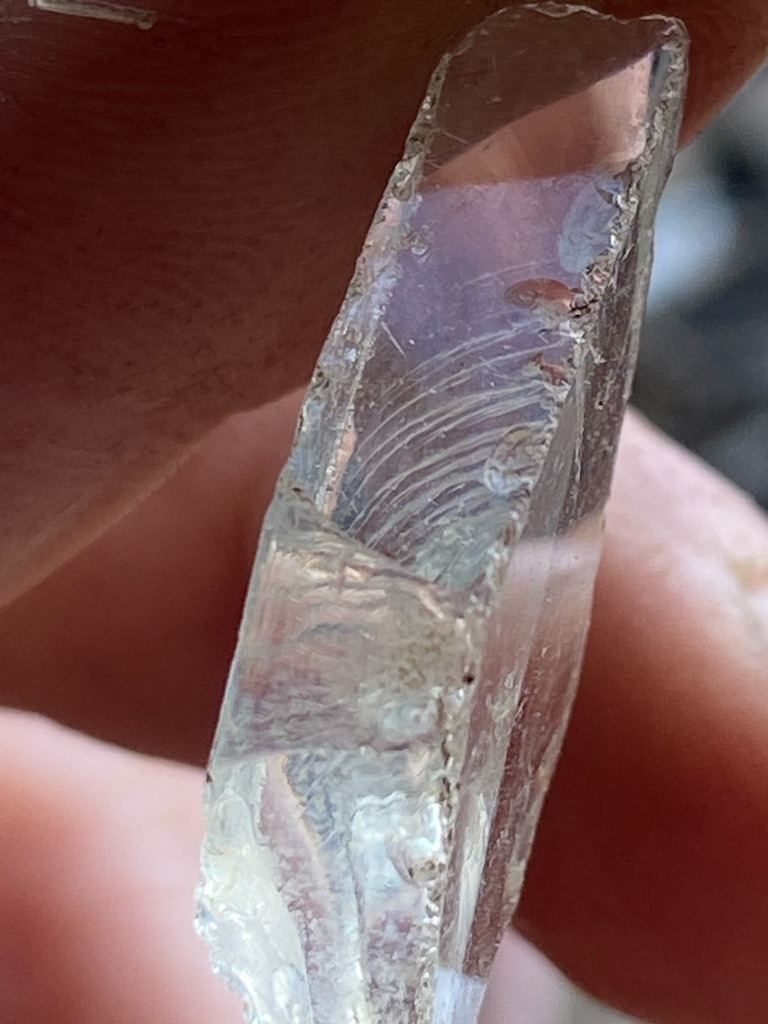
Not a diamond; likely quartz, glass, or a synthetic silicate crystal displaying conchoidal fracture and distinct curved striations.
Not a diamond; likely quartz, glass, or a synthetic silicate crystal displaying conchoidal fracture and distinct curved striations. · Raw, unpolished, irregular fragment with natural or broken cleavage/fracture planes.
Not applicable (raw, uncut, unpolished fragment with crude fracture surfaces). Cut
Carat
Cannot be reliably determined visually without density testing and precise measurements, but roughly estimated at 5-15 carats equivalent volume.
Color
Near-colorless to very light yellowish-grey.
Clarity
Included / Imperfect due to numerous internal fractures, surface pitting, and conchoidal growth lines.
Shape
Raw, unpolished, irregular fragment with natural or broken cleavage/fracture planes.
Overall Assessment
Based on visual characteristics such as conchoidal fracture patterns, curved striations, and lack of diamond adamantine luster, this specimen is definitively not a diamond. It is most likely a raw quartz crystal fragment or a piece of industrial glass.
Cut Quality
Not applicable (raw, uncut, unpolished fragment with crude fracture surfaces).
Brilliance
Low to moderate vitreous luster, significantly limited by internal fracturing.
Fire
Minimal to none, characteristic of quartz or glass rather than diamond.
Scintillation
Poor, lacking standard facet arrangement to reflect and return light effectively.
Proportions
Non-standard; irregular slab-like thickness and uneven edges.
Symmetry
Asymmetrical due to irregular natural formation and fracturing.
Polish
Unpolished; rough fracture surfaces and natural crystal faces.
Fluorescence
Indeterminate without UV testing equipment.
Inclusions
Conchoidal fracture lines, internal stress cracks, and potential particulate inclusions.
Blemishes
Surface chips, rough edges, abrasion marks, and pitting.
Origin
Natural mineral specimen (such as quartz) or manufactured glass cullet.
Treatment Detection
No obvious artificial treatments detected, though standard gemological testing (refractive index, polariscope) is required to differentiate glass from crystalline quartz.
Estimated Value
Nominal to negligible gemstone value, as this is likely common quartz, industrial slag, or glass waste.
Certification Estimate
Standard gemological laboratories (GIA, IGI) would not issue a diamond grading report for this material as it is not diamond.
Investment Potential
None as an investment; educational or decorative curiosity value only.
Similar Diamonds
None, as this material is visually and physically distinct from diamond in hardness, luster, and crystal structure.
Setting Suggestions
Not recommended for fine jewelry due to softness (if quartz) or fragility (if glass); better suited as a raw mineral specimen display piece.
Care & Maintenance
Store carefully to prevent further chipping along existing fracture lines; clean gently with warm soapy water and a soft brush.
Interesting Facts
The prominent curved lines visible on the surface are conchoidal fracture ripples, commonly seen when brittle amorphous materials or single-crystal minerals fracture under stress.