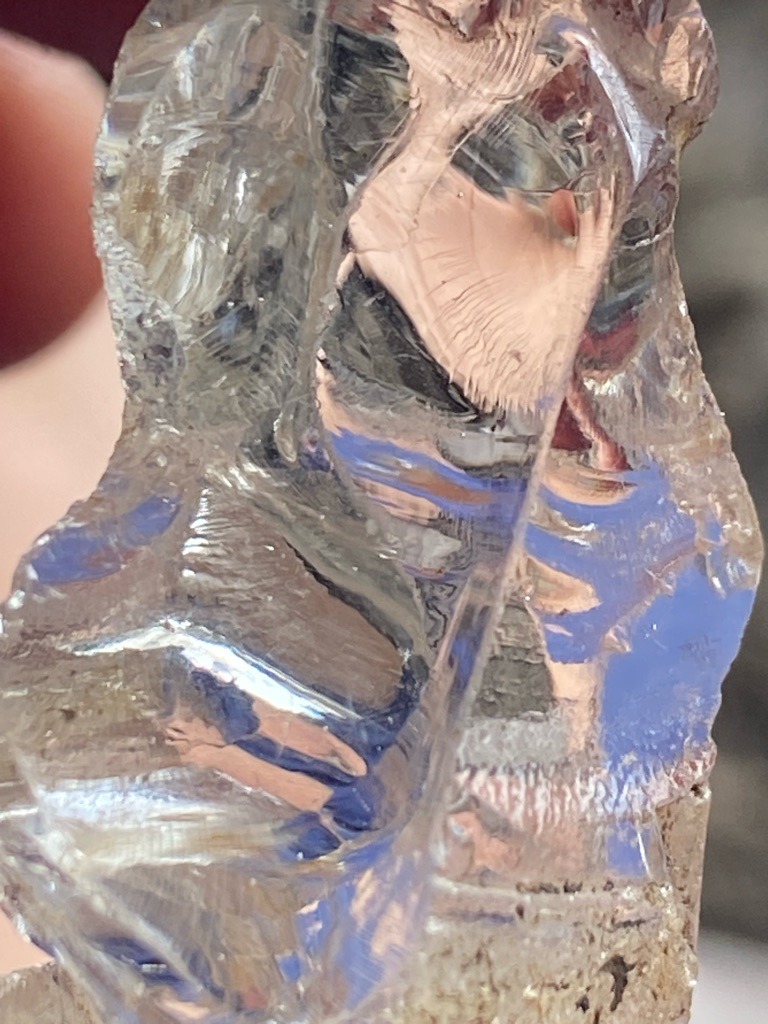
Not a diamond; appears to be raw quartz, glass slag, or another silicate mineral exhibiting conchoidal fracture
Not a diamond; appears to be raw quartz, glass slag, or another silicate mineral exhibiting conchoidal fracture · Rough / Raw irregular chunk with conchoidal fractures
Uncut / Raw (Not applicable) Cut
Carat
Exceeds standard gemstone ranges for cut stones; large specimen weight estimated visually over 50 carats
Color
Colorless to transparent with inclusions and internal reflections
Clarity
Included (I3 equivalent if graded as gem material due to heavy internal fractures and flaws)
Shape
Rough / Raw irregular chunk with conchoidal fractures
Overall Assessment
Visual analysis indicates this specimen is a raw mineral or slag glass rather than a diamond, characterized by prominent conchoidal fracturing and lack of crystalline diamond octahedral forms.
Cut Quality
Uncut / Raw (Not applicable)
Brilliance
Low to moderate due to lack of facet geometry
Fire
Minimal dispersion due to material properties and lack of precision cutting
Scintillation
Poor, lacking standard facet reflections
Proportions
Not applicable to raw rough material
Symmetry
Asymmetrical raw mineral formation
Polish
Unpolished natural or fractured surface
Fluorescence
Unknown without UV testing
Inclusions
Heavy internal stress fractures, conchoidal ripple marks, and potential gas bubbles if glass
Blemishes
Surface scratches, pitting, and rough edges
Origin
Natural mineral rough or industrial byproduct (slag glass)
Treatment Detection
None detected; appears in its raw/unprocessed state
Estimated Value
Nominal mineral specimen or decorative glass value (low market value)
Certification Estimate
Not eligible for GIA or major diamond grading reports as it is not diamond
Investment Potential
None as an investment gemstone
Similar Diamonds
None, as this specimen is not a diamond
Setting Suggestions
Wire-wrapped or custom bezel setting for raw mineral display
Care & Maintenance
Standard gentle cleaning with warm soapy water and a soft brush; avoid harsh impacts due to internal fracturing
Interesting Facts
The smooth, curved surfaces showing ripple marks are known as conchoidal fractures, typical of brittle materials like glass and quartz