Non-diamond (Likely Fluorite or Aventurine Quartz)
Non-diamond (Likely Fluorite or Aventurine Quartz) · Rough / Uncut / Natural Tumbled
Not Applicable (Rough/Tumbled) Cut
Carat
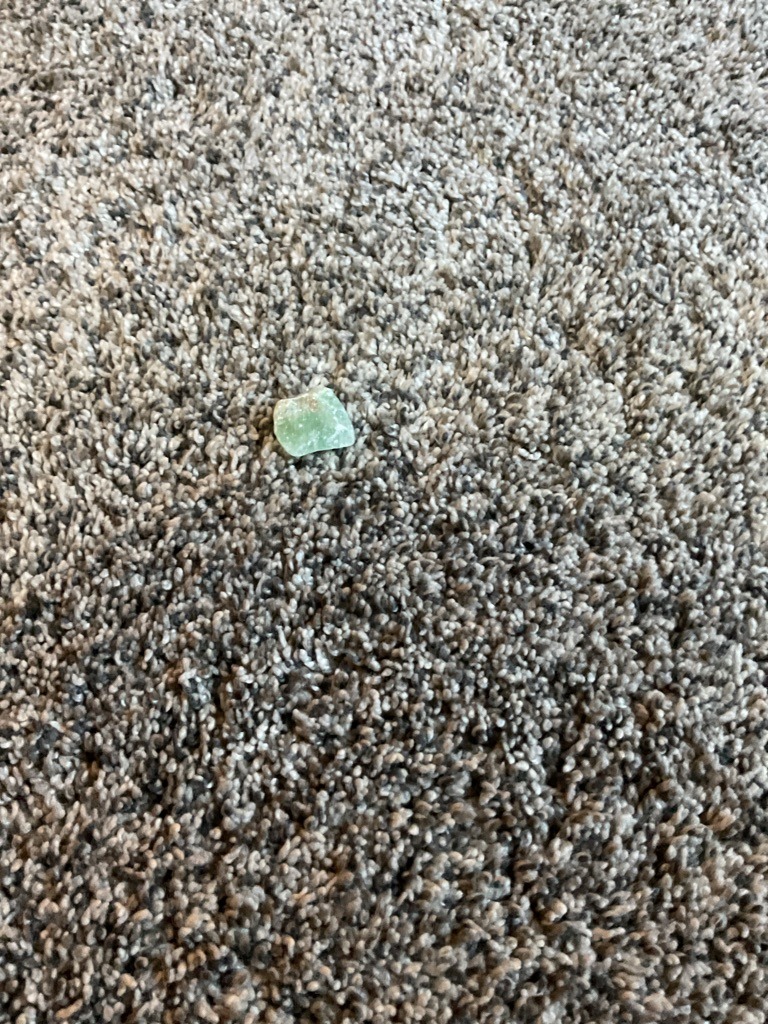
Estimated 1.5 to 3.0 carats based on size relative to carpet fibers
Color
Pale Translucent Green
Clarity
Translucent (Significant internal cloudiness/graininess)
Shape
Rough / Uncut / Natural Tumbled
Overall Assessment
This is a translucent green mineral specimen, not a diamond. It lacks the crystal structure, luster, and refractive index associated with both natural and lab-grown diamonds.
Cut Quality
Not Applicable (Rough/Tumbled)
Brilliance
Low (Lack of facets prevent reflection)
Fire
None (Translucent material lacks dispersion)
Scintillation
None
Proportions
Asymmetric natural specimen
Symmetry
Poor (Natural irregular form)
Polish
Dull / Natural Matte
Fluorescence
Unknown (Requires UV light exposure)
Inclusions
Heavy internal cloudiness, potential mineral inclusions, and internal fractures
Blemishes
Surface abrasions and irregular pitting across the exterior
Origin
Likely a tumbled terrestrial mineral such as green quartz or fluorite
Treatment Detection
Possibly tumbled or polished to remove sharp edges
Estimated Value
Minimal ($1 to $10 as a mineral specimen)
Certification Estimate
Not suitable for standard diamond grading (GIA/IGI)
Investment Potential
Low to none (Common mineral specimen)
Similar Diamonds
None (This is not a diamond; mimics green rough beryl or fluorite)
Setting Suggestions
Wire wrapping for a necklace or inclusion in a small mineral collection box
Care & Maintenance
Keep away from acids and harder gemstones to prevent scratching
Interesting Facts
While green diamonds exist, they are extremely rare and typically show a high refractive index not seen here. This specimen's waxy luster is characteristic of many common silicate minerals.