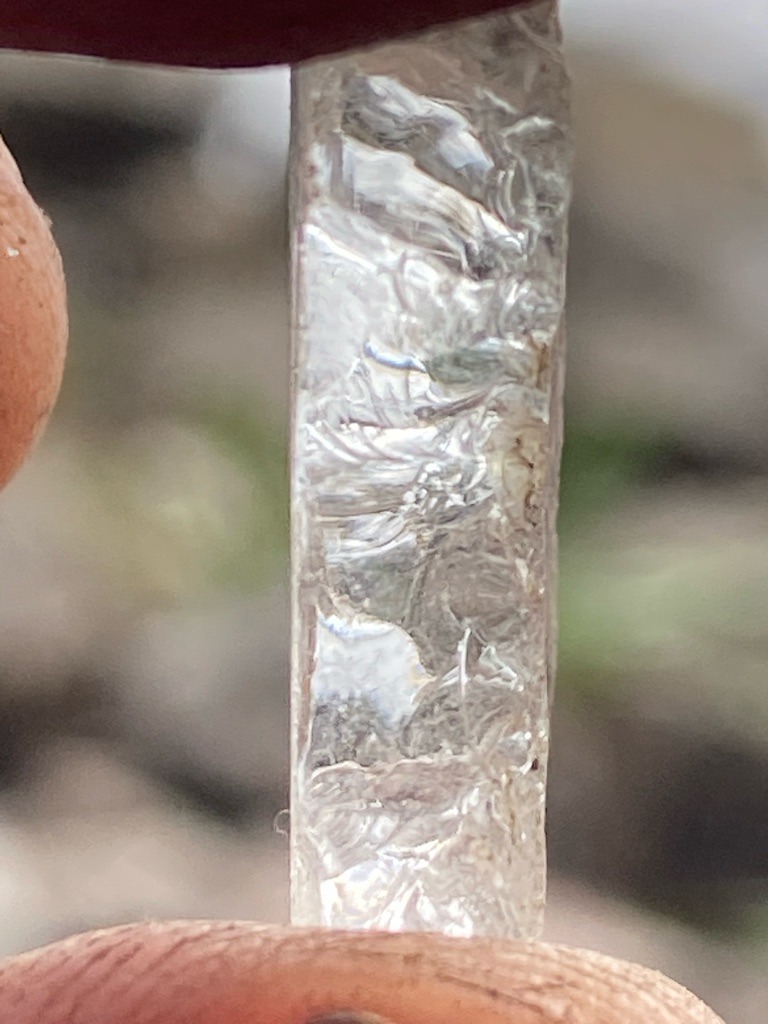
Natural rough diamond crystal, likely gem-quality or industrial-grade depending on exact internal flaws, displaying characteristic natural surface etchings and crystal habit.
Natural rough diamond crystal, likely gem-quality or industrial-grade depending on exact internal flaws, displaying characteristic natural surface etchings and crystal habit. · Uncut rough crystal, elongated tabular or distorted flat crystal habit, not faceted.
Not applicable (uncut rough stone; would require custom cutting to achieve a faceted grade). Cut
Carat
Estimated between 2.0 to 4.0 carats based on visual dimensions relative to the fingers holding it.
Color
Near-colorless to faint yellow/brown tint (approx. G-J range), common in natural rough stones.
Clarity
Estimated SI1 to I1 (Included), as rough surfaces and internal natural inclusions (feathers, cloud formations) are visible through the translucent faces.
Shape
Uncut rough crystal, elongated tabular or distorted flat crystal habit, not faceted.
Overall Assessment
An intriguing, natural rough diamond crystal displaying classic raw geological features, well-suited for mineral collectors or custom organic jewelry design.
Cut Quality
Not applicable (uncut rough stone; would require custom cutting to achieve a faceted grade).
Brilliance
Low brilliance in its current rough state due to unpolished, irregular surfaces diffusing light rather than refracting it.
Fire
Minimal dispersion visible through the rough surface; fire will only emerge once properly cut and polished.
Scintillation
Absent in rough form; scintillation requires polished facets and specific angles.
Proportions
Not applicable to rough stones; shape is dictated by natural geological crystallization rather than faceted proportions.
Symmetry
Natural crystal symmetry (isometric system, distorted flattened tabular or blade-like habit with growth lines and triangular etchings/trigons).
Polish
Natural unpolished surface, showing typical raw crystal features like striations, pitting, and etching patterns.
Fluorescence
Cannot be definitively determined without UV testing, though many natural rough diamonds show blue or yellow fluorescence.
Inclusions
Internal natural mineral inclusions, micro-fractures, and feathers characteristic of unrefined natural crystal growth.
Blemishes
Natural surface features including trigons, growth lines, surface graining, and minor natural abrasions.
Origin
Likely alluvial or primary kimberlitic origin from an African deposit, Canada, Russia, or South America.
Treatment Detection
Untreated natural rough stone; no signs of enhancements, coatings, or artificial treatments.
Estimated Value
Varies widely based on internal clarity and potential recovery yield after cutting, roughly estimated between $500 to $2,000 USD for a specimen of this size and rough quality.
Certification Estimate
GIA or similar major gemological lab would issue a 'Rough Diamond Report' or 'Diamond Origin Report' confirming natural origin.
Investment Potential
Moderate value as a unique mineral specimen or collector's rough crystal, though speculative until cut and faceted.
Similar Diamonds
Other natural un-cut gem-quality rough diamond crystals of similar size and elongated tabular habit.
Setting Suggestions
Best preserved as a raw mineral specimen in a custom organic wire-wrap, bezel setting, or pendant designed to showcase its natural crystal structure.
Care & Maintenance
Clean with mild soapy water and a soft brush; avoid harsh chemicals and protect from impact against hard surfaces despite extreme hardness.
Interesting Facts
The rough surface often features 'trigons' (small triangular depressions), which are natural etch marks formed by dissolving fluids deep within the Earth's mantle.