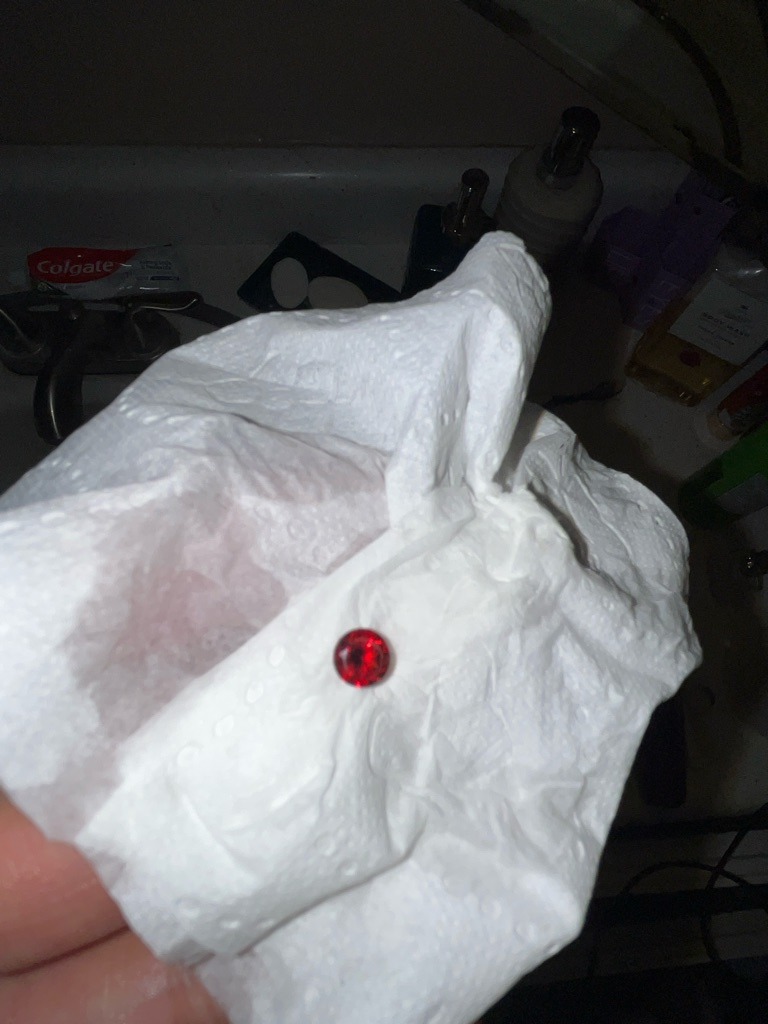
Not a diamond; this gemstone appears to be a ruby or a red-colored synthetic simulant (such as cubic zirconia or glass) due to its vibrant red coloration, as natural diamonds do not typically occur in this shade of saturated red without intense fancy color grading (and even then, genuine red diamonds are extremely rare).
Not a diamond; this gemstone appears to be a ruby or a red-colored synthetic simulant (such as cubic zirconia or glass) due to its vibrant red coloration, as natural diamonds do not typically occur in this shade of saturated red without intense fancy color grading (and even then, genuine red diamonds are extremely rare). · Round Brilliant
Good Cut
Carat
Approximately 0.50 to 0.75 carats based on visual scale against the paper towel.
Color
Fancy Intense Red (or saturated red simulant)
Clarity
Visually appears relatively clean, estimated at VS1-VS2 equivalent under casual observation.
Shape
Round Brilliant
Overall Assessment
The item is a vibrant red gemstone resting on a paper towel. Given its deep red color, it is almost certainly not a diamond, but rather a ruby, colored sapphire, or synthetic simulant requiring physical gemological examination for precise identification.
Cut Quality
Good
Brilliance
Moderate, limited by the deep red body color which absorbs much of the white light.
Fire
Low to moderate, typical of colored stones or simulants rather than a diamond.
Scintillation
Displays standard facet-based light return under direct light.
Proportions
Standard round brilliant proportions cannot be precisely measured from this angle.
Symmetry
Good
Polish
Good
Fluorescence
Cannot be definitively determined without UV testing, but likely inert or moderate.
Inclusions
None immediately visible to the naked eye in this lighting.
Blemishes
None readily apparent.
Origin
Uncertain; requires advanced spectroscopy or inclusion analysis.
Treatment Detection
Cannot be confirmed visually; potential heat treatment if natural corundum.
Estimated Value
Varies wildly depending on material confirmation: minimal if glass/CZ, potentially hundreds to thousands if a genuine natural ruby.
Certification Estimate
Would require professional gemological lab testing (GIA or GRS) to determine if natural ruby, lab-created corundum, or simulant.
Investment Potential
Low unless confirmed as a rare natural untreated ruby of significant quality.
Similar Diamonds
N/A (as this is a red gemstone/simulant rather than a diamond).
Setting Suggestions
Classic prong or bezel setting in yellow gold or white gold to enhance the red hue.
Care & Maintenance
Clean with warm soapy water and a soft brush; avoid harsh ultrasonic cleaners if inclusion-filled.
Interesting Facts
Natural red diamonds are among the rarest colored diamonds in the world, whereas vivid red stones encountered casually are almost always rubies or simulants.