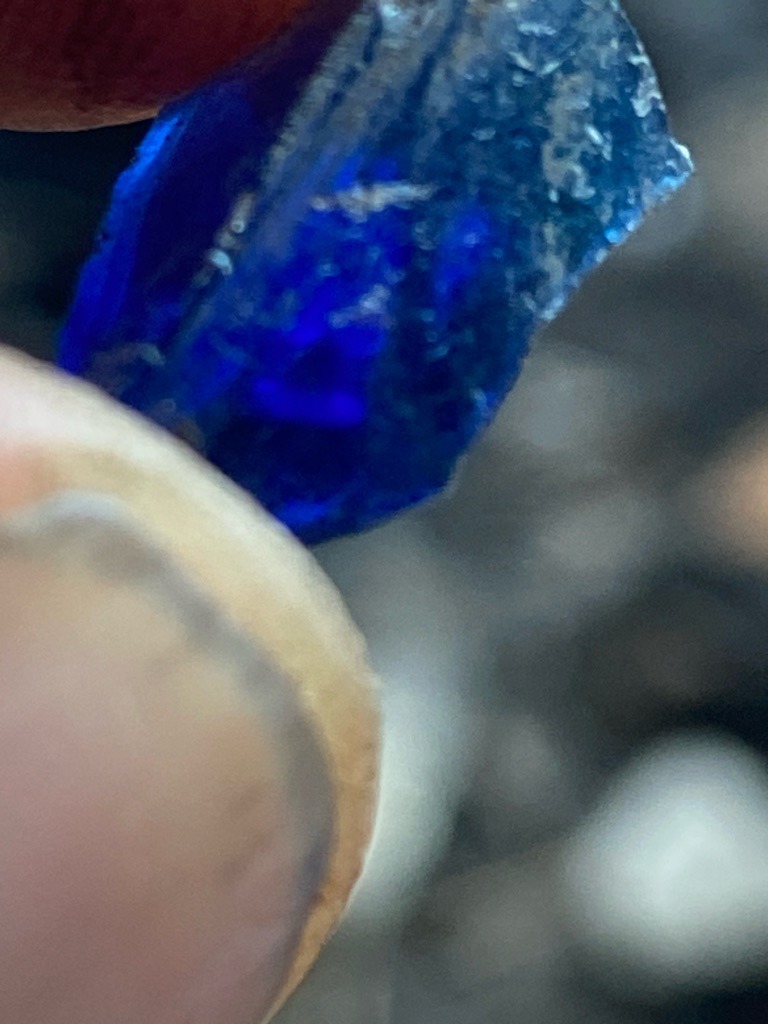
Not a diamond; this specimen appears to be a natural rough blue gemstone, likely sapphire or a similar silicate/oxide mineral given the vivid blue coloration.
Not a diamond; this specimen appears to be a natural rough blue gemstone, likely sapphire or a similar silicate/oxide mineral given the vivid blue coloration. · Uncut rough crystal, irregular raw formation
Not applicable (Rough, un-faceted stone) Cut
Carat
Estimated approximately 2.0 to 4.0 carats based on visual scale against fingers
Color
Fancy Deep Blue
Clarity
Included (Contains noticeable internal fractures, cloudiness, and crystal inclusions)
Shape
Uncut rough crystal, irregular raw formation
Overall Assessment
An interesting natural rough blue crystal specimen. While commonly mistaken for fancy blue diamonds by novices due to the vivid color, detailed gemological testing is required to confirm the exact mineral species.
Cut Quality
Not applicable (Rough, un-faceted stone)
Brilliance
Low to moderate, limited by rough surface and inclusions
Fire
Minimal to none due to lack of facets and saturated body color
Scintillation
Absent due to un-faceted, rough state
Proportions
Not applicable to rough uncut stones
Symmetry
Asymmetrical due to natural raw crystallization
Polish
Unpolished, natural rough surface texture
Fluorescence
Indeterminate from visual assessment alone
Inclusions
Visible internal fractures, feathering, and inclusions typical of rough corundum or similar minerals
Blemishes
Natural surface irregularities, rough patches, and cleavage planes
Origin
Natural rough gemstone origin, potentially alluvial deposit
Treatment Detection
Requires advanced gemological testing (spectroscopy/microscopy) to rule out diffusion or heat treatment if it is sapphire
Estimated Value
Varies significantly depending on precise mineral identification, transparency, and weight after cutting (typically lower for heavily included rough)
Certification Estimate
Gemological laboratories such as GIA or GRS would issue a Colored Stone Identification Report rather than a diamond report
Investment Potential
Low to moderate as rough; potential increases significantly if successfully cut and polished into a clean faceted gemstone
Similar Diamonds
None, as this is a colored gemstone rough rather than a diamond
Setting Suggestions
Custom wire-wrapped setting or bespoke organic bezel setting once cut and polished
Care & Maintenance
Store separately to prevent scratching softer stones; clean gently with warm soapy water and a soft brush
Interesting Facts
Vivid blue rough stones are frequently found in secondary alluvial deposits where softer matrix rock has eroded away