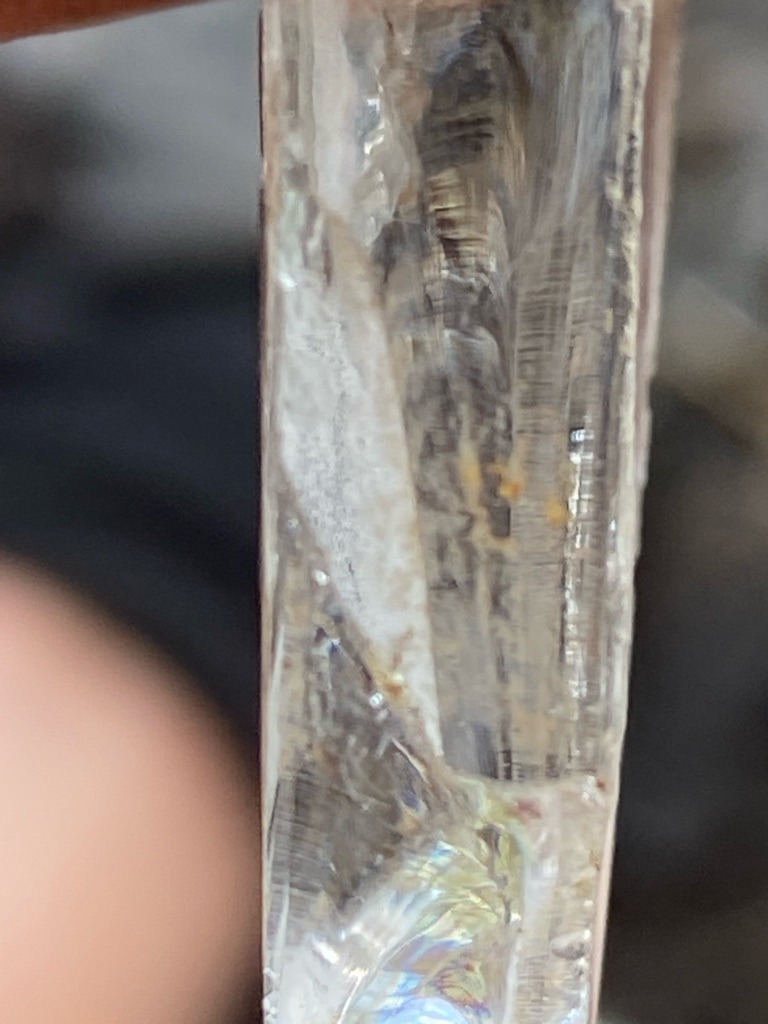
Natural rough diamond / mineral specimen showing distinctive crystal growth lines (trigons or growth steps) and inclusions
Natural rough diamond / mineral specimen showing distinctive crystal growth lines (trigons or growth steps) and inclusions · Rough crystal / Uncut elongated crystal structure
Not Applicable (Uncut rough specimen) Cut
Carat
Difficult to estimate accurately from visual macro photograph alone, potentially 2.0 to 5.0+ carats based on visible elongation and thickness
Color
Near-colorless to faintly tinted (likely around H-J range or lower due to visible inclusions and brownish/yellowish tinges)
Clarity
I1 to I3 (Included), with prominent internal feather fractures, cleavage planes, and mineral inclusions visible
Shape
Rough crystal / Uncut elongated crystal structure
Overall Assessment
This is a fascinating, natural rough diamond crystal featuring prominent growth lines, natural surface textures, and internal inclusions, representing the raw geological state before human craftsmanship.
Cut Quality
Not Applicable (Uncut rough specimen)
Brilliance
Low to moderate due to uncut, unpolished state and internal fracturing
Fire
Minimal dispersion visible on the rough surface
Scintillation
Poor due to lack of standard facet geometry
Proportions
Not Applicable for uncut rough
Symmetry
Natural crystal symmetry showing elongated octahedral or distorted growth habit
Polish
Unpolished natural crystal faces with striations and etch channels
Fluorescence
Cannot be determined without UV light testing (typically varies from None to Medium in rough stones)
Inclusions
Heavy internal feathers, clouds, potential mineral inclusions (like tiny sulfides), and natural cleavage planes
Blemishes
Natural surface trigons, etch marks, and rough skin typical of unworked crystals
Origin
Likely alluvial or primary pipe deposit origin (African, Canadian, or Russian rough origin typical for such specimens)
Treatment Detection
No signs of artificial treatments; completely natural as mined
Estimated Value
Industrial to lower commercial gem grade value; heavily dependent on whether it can be successfully cut into a clean polished stone
Certification Estimate
Gemological reports for rough stones are less common unless certified for origin or export; major labs like GIA issue Rough Diamond Reports or Kimberley Process certificates
Investment Potential
Low as a standard financial investment; higher collectible value for mineral enthusiasts and educational display
Similar Diamonds
Other unpolished natural diamond crystals and rough industrial-grade diamond specimens
Setting Suggestions
Best kept as a raw mineral specimen or custom-set in an organic, rustic wire-wrap or bezel setting designed to protect fragile rough edges
Care & Maintenance
Handle with care; rough diamonds have cleavage planes that can cause the stone to split or fracture if dropped or subjected to sharp impacts
Interesting Facts
The visible linear striations on the surface are growth lines that tell the story of the intense heat and pressure deep within the Earth's mantle where the diamond formed