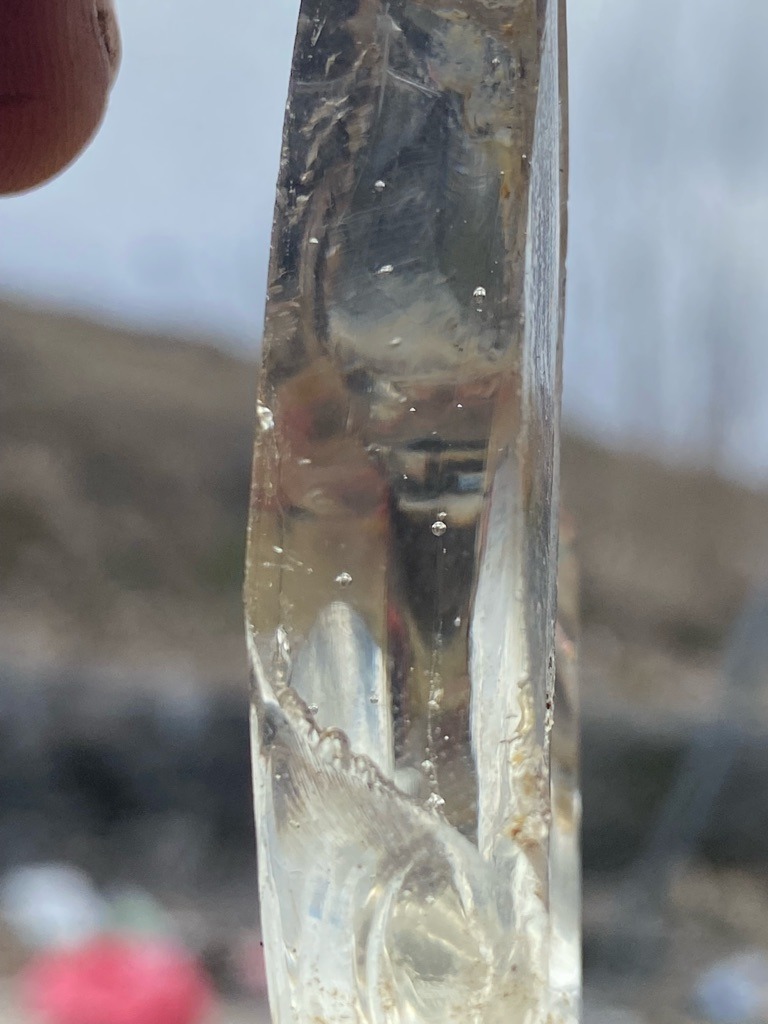
The specimen appears to be non-diamond, following more closely with natural Quartz or Glass based on the conchoidal fracture patterns and air bubbles.
The specimen appears to be non-diamond, following more closely with natural Quartz or Glass based on the conchoidal fracture patterns and air bubbles. · Rough / Uncut (Natural elongated crystal fragment)
N/A (Uncut specimen) Cut
Carat
Estimated 20-40 carats based on size relative to the fingers
Color
Light Brown / Champagne (equivalent to roughly K-M or Champagne on a fancy scale)
Clarity
I3 / Included (contains significant internal fractures and bubbles visible to the naked eye)
Shape
Rough / Uncut (Natural elongated crystal fragment)
Overall Assessment
The specimen does not exhibit the crystal habit, luster, or fracture characteristics of a diamond. It is likely a fragment of smoky quartz or man-made glass.
Cut Quality
N/A (Uncut specimen)
Brilliance
Low; surface matte and internal fractures prevent light return
Fire
None detected; the dispersion is too low for this material specifically
Scintillation
None; lacks facets or clean planes to create scintillation
Proportions
N/A (Indeterminate for rough stone)
Symmetry
Poor (Rough/Broken specimen)
Polish
N/A (Natural/Fracture surface)
Fluorescence
Indeterminate from the image, but quartz typically shows no fluorescence
Inclusions
Round gas bubbles and heavy internal conchoidal fracture lines
Blemishes
Large surface fractures, chips, and dirt/residue
Origin
Terrestrial mineral deposit (Quartz) or anthropogenic (Glass)
Treatment Detection
N/A (Likely untreated natural rough material or simple glass melt)
Estimated Value
$5 - $50 (Typical for common rough quartz or glass slag specimens)
Certification Estimate
N/A (Likely not suitable for GIA/IGI diamond grading; would require a Gem Identification Report)
Investment Potential
None; common mineral specimen
Similar Diamonds
Brown rough industrial diamonds (though this likely is not a diamond)
Setting Suggestions
Wire wrapping for a pendant or mineral collection display
Care & Maintenance
Avoid impact; clean with warm soapy water and a soft brush
Interesting Facts
The conchoidal fracture (shell-like curves) at the bottom is a diagnostic feature of silica-based materials like quartz or glass, whereas diamonds have octahedral cleavage.