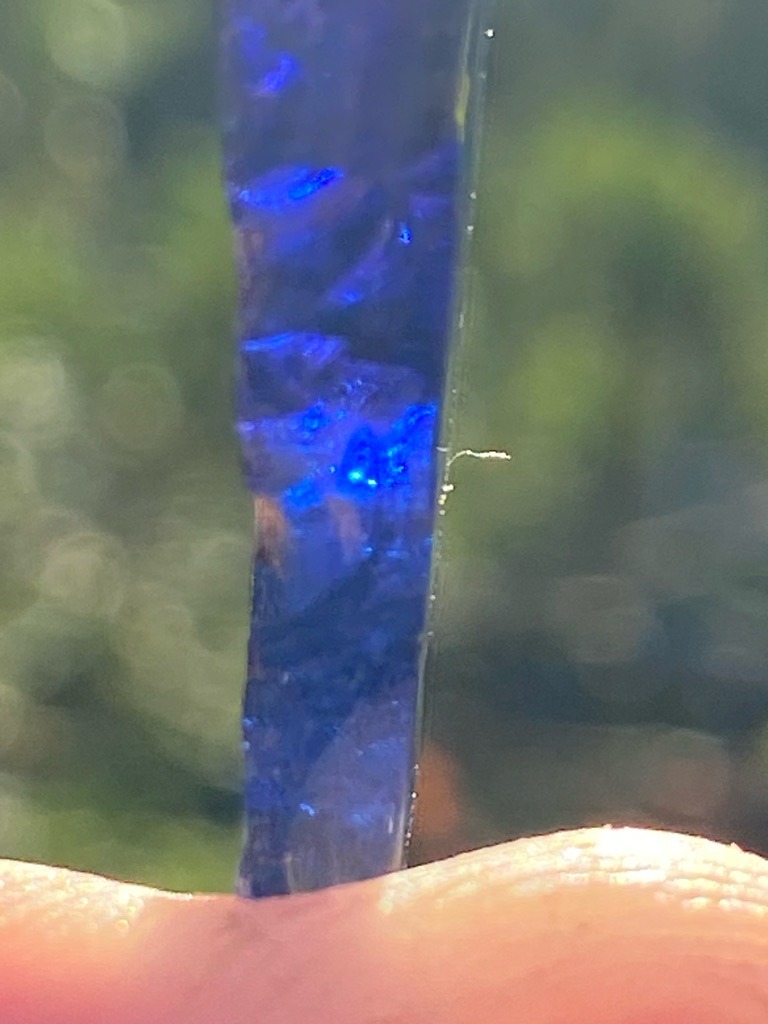
Not a diamond; this specimen appears to be an uncut, elongated mineral crystal or gemstone rough, potentially a sapphire, tanzanite, or opal showing intense blue play-of-color/fluorescence.
Not a diamond; this specimen appears to be an uncut, elongated mineral crystal or gemstone rough, potentially a sapphire, tanzanite, or opal showing intense blue play-of-color/fluorescence. · Rough crystal / Uncut elongated crystal form
Not applicable (Rough crystal form, unpolished and uncut) Cut
Carat
Cannot be precisely determined visually, rough estimate ranges between 2 to 5 carats depending on density and exact dimensions.
Color
Deep vivid blue with intense blue luminescence
Clarity
Included (Contains visible internal fractures, veils, and mineral inclusions characteristic of rough stones)
Shape
Rough crystal / Uncut elongated crystal form
Overall Assessment
An intriguing, natural rough crystal exhibiting striking vibrant blue internal light phenomena. While it lacks the optical properties and classification of a diamond, it possesses unique raw aesthetic appeal suitable for collector displays or organic jewelry designs.
Cut Quality
Not applicable (Rough crystal form, unpolished and uncut)
Brilliance
Low to moderate due to rough, unpolished surfaces preventing optimal internal light refraction.
Fire
Minimal to none in its current rough state.
Scintillation
Limited flash effect restricted to localized internal planes reflecting light.
Proportions
Elongated tabular or prismatic rough crystal habit; standard faceted proportions do not apply.
Symmetry
Asymmetrical, natural crystal formation
Polish
Unpolished natural crystal faces or fracture surfaces
Fluorescence
Strong to Very Strong Blue under UV or specific lighting conditions
Inclusions
Abundant internal feather fractures, cloud-like inclusions, and potential mineral crystal inclusions typical of unrefined rough material.
Blemishes
Natural surface etching, rough growth lines, and potential chipping along edges.
Origin
Natural rough mineral, exact geographic origin indeterminable by visual inspection alone.
Treatment Detection
No obvious signs of artificial treatments, appears entirely natural in its rough state.
Estimated Value
Nominal value as a rough mineral specimen, highly dependent on the exact mineral species (e.g., rough sapphire vs. opal vs. tanzanite).
Certification Estimate
Not applicable for standard diamond grading labs (GIA/AGS). Gemological institutes (like GIA or GRS) would issue a colored stone identification report if submitted.
Investment Potential
Low for investment-grade portfolios; valued primarily as a collector's mineral specimen or for bespoke artisan jewelry.
Similar Diamonds
None, as this is not a diamond.
Setting Suggestions
Wire-wrapped in sterling silver or gold, or custom-designed organic prong setting to preserve the raw, natural aesthetic of the crystal.
Care & Maintenance
Store separately in a soft pouch to prevent scratching other stones or damaging the brittle edges of the raw crystal; avoid harsh chemicals and ultrasonic cleaners.
Interesting Facts
Raw, uncut crystals often display intense localized color phenomena, such as fluorescence or play-of-color, that become altered or redistributed once faceted.