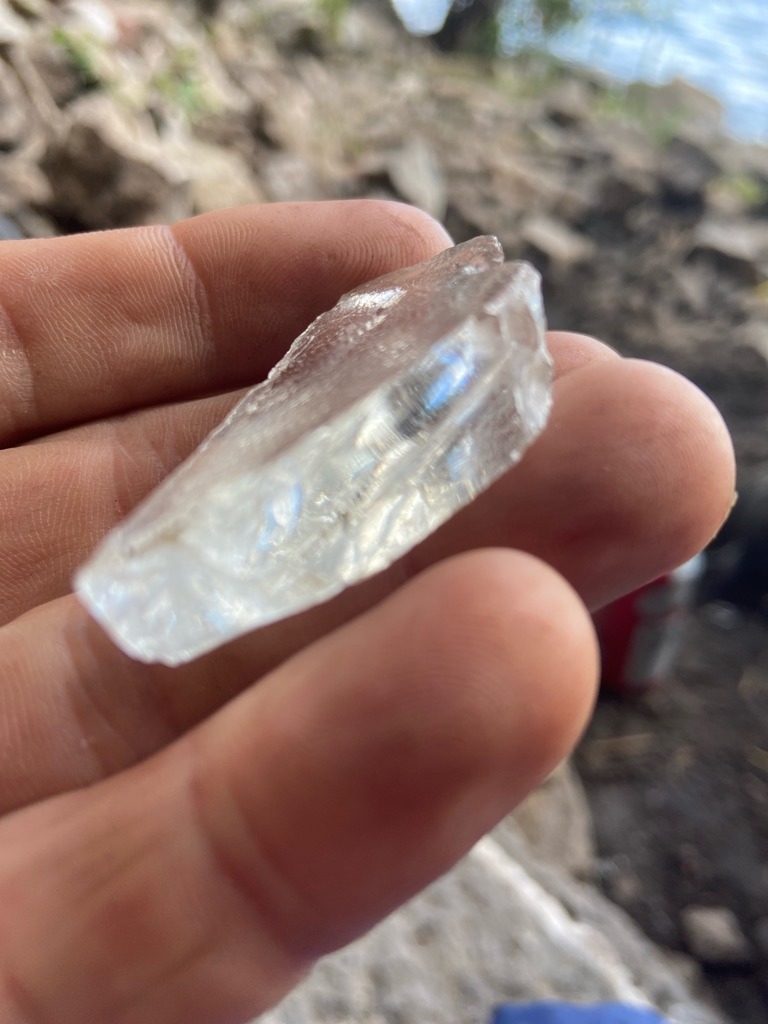
Not a diamond; visual inspection suggests raw quartz or glass/slag fragment.
Not a diamond; visual inspection suggests raw quartz or glass/slag fragment. · Rough uncut irregular fragment
Not applicable (uncut raw mineral or glass) Cut
Carat
Estimated around 15-25 carats equivalent based on size, but not applicable since it is not a diamond.
Color
Colorless / Transparent
Clarity
Included / Heavily flawed relative to gemstone grading standards
Shape
Rough uncut irregular fragment
Overall Assessment
The specimen shown in the image is a transparent, irregularly shaped raw mineral or glass fragment, not a diamond. It lacks the adamantine luster, high refractive index, and optical characteristics characteristic of diamond rough.
Cut Quality
Not applicable (uncut raw mineral or glass)
Brilliance
Low to moderate vitreous luster
Fire
Very low dispersion compared to diamond
Scintillation
Poor due to lack of standard facets
Proportions
Irregular proportions
Symmetry
Asymmetrical raw form
Polish
Unpolished natural or weathered surface
Fluorescence
Unknown without UV testing
Inclusions
Heavy internal fracturing and inclusions
Blemishes
Surface pitting, abrasion, and chips
Origin
Terrestrial mineral or anthropogenic glass fragment found outdoors
Treatment Detection
None apparent, likely in its natural raw state or as discarded glass
Estimated Value
Nominal / Low (essentially worthless as a gemstone; value depends on mineral specimen novelty if genuine quartz, likely negligible if glass)
Certification Estimate
Gemological laboratories would not issue a diamond certificate; would require standard mineralogical identification (e.g., GIA colored stone or identification report).
Investment Potential
None as an investment asset
Similar Diamonds
None, as this specimen shares no optical or physical properties with a genuine diamond
Setting Suggestions
Not recommended for fine jewelry settings due to softness (if quartz) or fragility (if glass)
Care & Maintenance
Standard handling; avoid harsh impacts to prevent shattering
Interesting Facts
Many transparent rough minerals found outdoors are mistaken for rough diamonds by amateurs, most commonly being quartz, calcite, or glass.