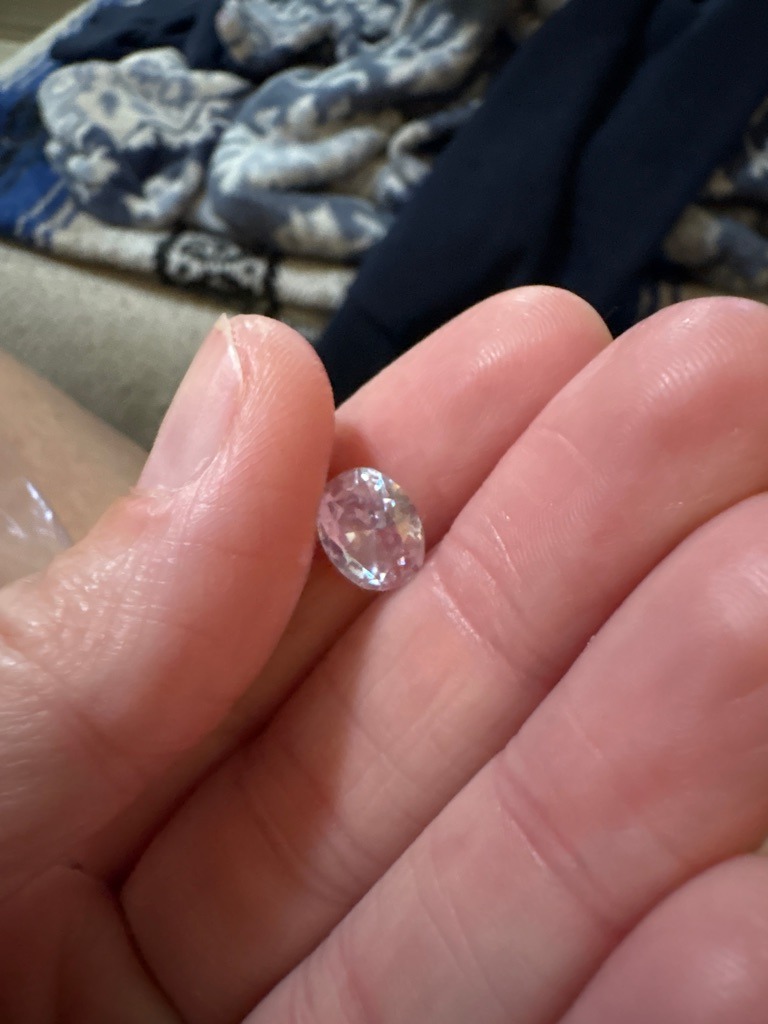
Likely diamond simulant (such as Cubic Zirconia or Moissanite) due to visual dispersion characteristics, or potentially a lab-grown diamond requiring further physical testing.
Likely diamond simulant (such as Cubic Zirconia or Moissanite) due to visual dispersion characteristics, or potentially a lab-grown diamond requiring further physical testing. · Oval Brilliant
Very Good, displaying balanced proportions and symmetrical facet alignment typical of commercial brilliant cuts. Cut
Carat
Estimated at approximately 2.5 to 3.0 carats based on visual proportions relative to human fingers.
Color
Estimated G-H near colorless, though high dispersion makes precise color grading difficult from a single photo.
Clarity
Estimated VS1-VS2, appearing relatively clean to the naked eye under this lighting.
Shape
Oval Brilliant
Overall Assessment
A visually appealing, brightly faceted oval gemstone with good sparkle and proportions. Professional physical testing (such as thermal/electrical conductivity or spectroscopy) is recommended to confirm its exact material composition.
Cut Quality
Very Good, displaying balanced proportions and symmetrical facet alignment typical of commercial brilliant cuts.
Brilliance
High brightness and white light return typical of well-cut modern faceting.
Fire
Strong spectral dispersion, exhibiting vibrant flashes of colored light characteristic of high refractive index materials.
Scintillation
Good play of light and dark areas as the stone moves, creating lively sparkle.
Proportions
Standard oval brilliant proportions with a moderate table and acceptable depth percentage.
Symmetry
Good to Very Good, with well-aligned facets forming a balanced oval outline.
Polish
Good, showing standard commercial surface finish quality without obvious abrasions.
Fluorescence
Unable to determine accurately without UV testing; likely None to Faint.
Inclusions
No prominent large inclusions visible at this magnification, suggesting eye-clean clarity.
Blemishes
No major surface blemishes immediately apparent from the visual angle.
Origin
Cannot be definitively determined from a photograph; requires spectroscopic and microscopic gemological testing.
Treatment Detection
No obvious visible treatments detected visually, but advanced laboratory testing is required to rule out HPHT or coatings.
Estimated Value
Depends heavily on material verification: from $50–$100 if cubic zirconia, up to thousands if natural or lab-grown diamond.
Certification Estimate
If natural/lab-grown diamond, likely eligible for GIA or IGI grading; if simulant, requires retail jewelry store evaluation.
Investment Potential
Low if identified as a diamond simulant; moderate if lab-grown; standard for natural gemstones depending on certification.
Similar Diamonds
Standard commercial oval brilliant cut diamonds of similar size and near-colorless grade.
Setting Suggestions
Classic prong setting in white gold, platinum, or yellow gold to maximize light entry and securely hold the oval shape.
Care & Maintenance
Clean regularly with warm soapy water and a soft brush; store separately in a fabric-lined box to prevent scratching other jewelry.
Interesting Facts
Oval cuts are known for creating an optical illusion that makes the stone appear larger than its actual carat weight while elongating the finger.