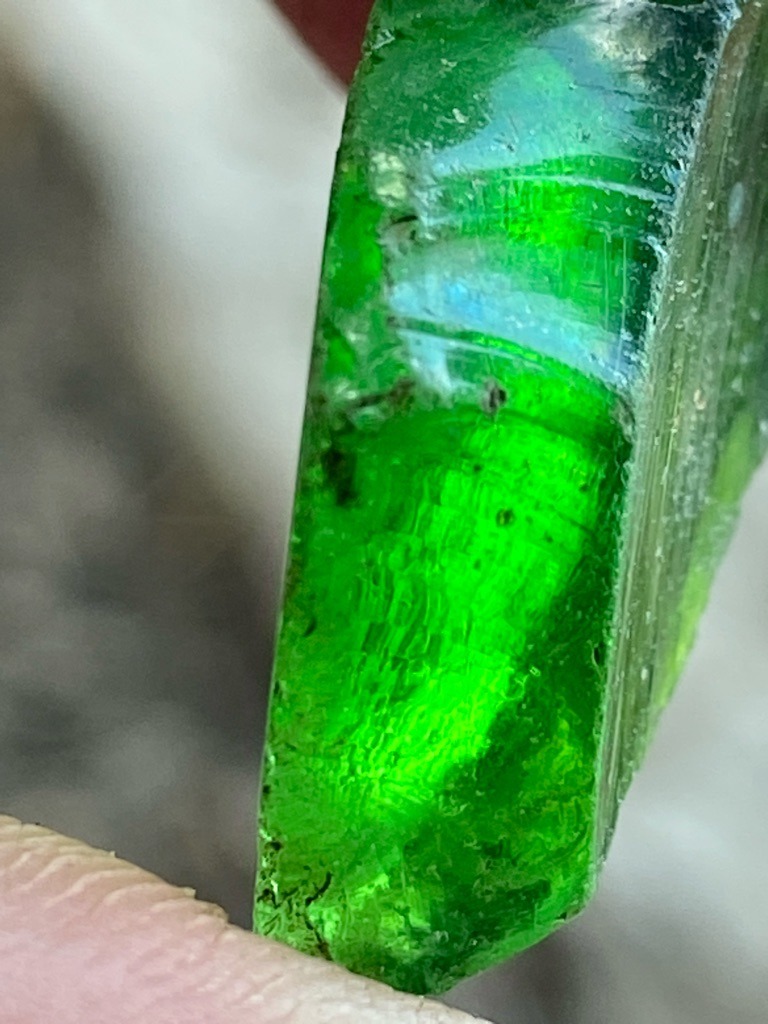
Not a diamond; this is a rough green mineral specimen, likely colored glass, synthetic quartz, or a beryl variant such as emerald, showing characteristic conchoidal fracture and surface striations.
Not a diamond; this is a rough green mineral specimen, likely colored glass, synthetic quartz, or a beryl variant such as emerald, showing characteristic conchoidal fracture and surface striations. · Rough crystal / Uncut specimen with elongated prismatic habit
Not applicable (Raw, uncut mineral rough with natural faces and fractures) Cut
Carat
Cannot accurately estimate without dimensions and density testing; visual size suggests a substantial specimen piece (approx. 10-25 carats equivalent volume)
Color
Vivid Green (Fancy Intense/Vivid Green equivalent)
Clarity
Included (Contains visible internal fractures, gas bubbles or inclusions, and surface striations)
Shape
Rough crystal / Uncut specimen with elongated prismatic habit
Overall Assessment
The specimen displayed is not a diamond, but rather a vivid green rough mineral or glass piece featuring prominent surface striations and fracture patterns. Professional gemological testing (refractive index, specific gravity, spectroscopy) is recommended to definitively identify the exact mineral species.
Cut Quality
Not applicable (Raw, uncut mineral rough with natural faces and fractures)
Brilliance
Vitreous to sub-adamantine luster on fractured surfaces, limited optical brilliance due to raw state and internal inclusions
Fire
Low to moderate fire, constrained by body color and rough surface texture
Scintillation
Poor scintillation due to lack of faceted geometry and presence of internal fractures
Proportions
Irregular raw crystal proportions with elongated vertical growth lines
Symmetry
Natural asymmetrical rough crystal formation
Polish
Raw, unpolished surface showing natural striations and conchoidal fracture ripples
Fluorescence
Indeterminate without UV testing, though some green minerals/glass exhibit inert or moderate reactive fluorescence.
Inclusions
Internal fracture planes, particulate inclusions, and possible gas bubbles typical of glass or hydrothermal growth
Blemishes
Surface chips, natural striations, rough edges, and abrasion marks
Origin
Unknown natural rough or man-made synthetic/glass production
Treatment Detection
Visual inspection shows potential molding lines or fracture characteristics common in treated rough or glass, requiring microscopic verification.
Estimated Value
Nominal value as a mineral specimen or rough material; low commercial value if identified as colored glass or synthetic material.
Certification Estimate
Not eligible for diamond grading labs (GIA, AGS); would require testing by a colored stone laboratory (like GIA Colored Stone or Gubelin) to confirm species.
Investment Potential
Minimal to none; raw non-precious mineral specimens or colored glass hold negligible investment value.
Similar Diamonds
None, as this is visually distinct from any diamond species (green diamonds of this vivid saturation are extremely rare and naturally faceted)
Setting Suggestions
Wire-wrapping or custom bezel setting if used as an organic/raw jewelry component
Care & Maintenance
Store separately to avoid scratching softer materials; clean gently with mild soap and warm water; avoid harsh chemicals and ultrasonic cleaners if fractures are present.
Interesting Facts
Vivid green rough specimens are frequently mistaken for precious emeralds or green diamonds, but closer inspection of striations and conchoidal fractures usually reveals quartz, beryl, or processed glass.