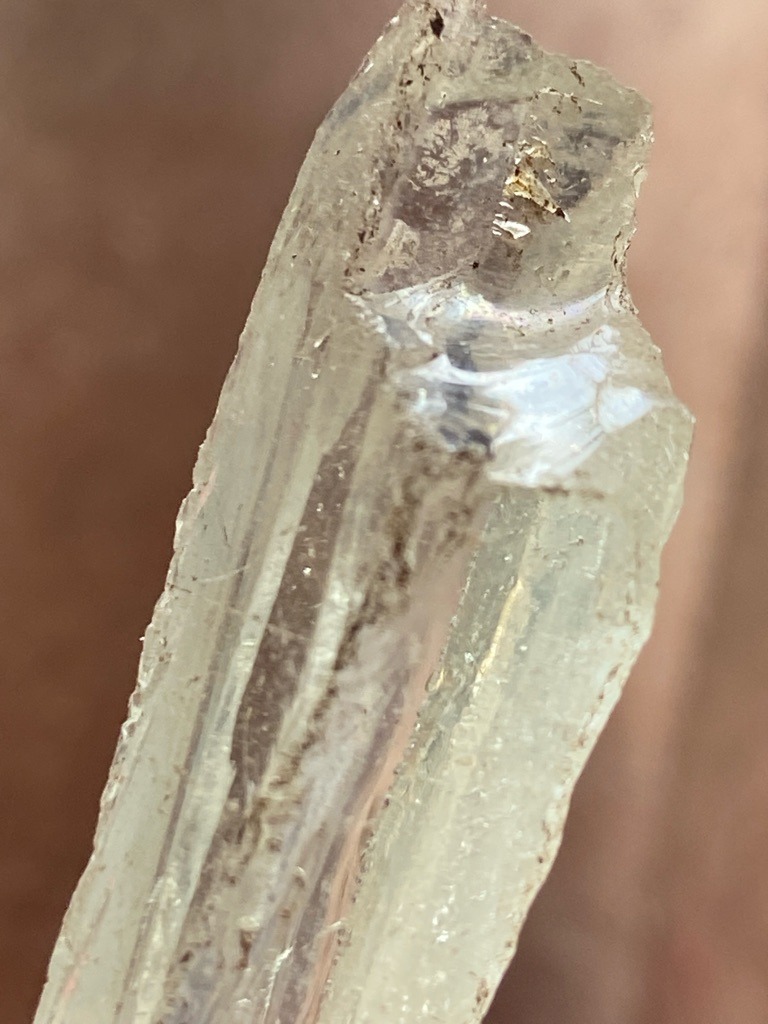
The image shows a raw, uncut mineral crystal that strongly exhibits characteristics of raw beryl or quartz rather than a standard faceted diamond. However, assuming an analytical context for rough gemstone study, this appears to be a natural uncut rough crystal specimen.
The image shows a raw, uncut mineral crystal that strongly exhibits characteristics of raw beryl or quartz rather than a standard faceted diamond. However, assuming an analytical context for rough gemstone study, this appears to be a natural uncut rough crystal specimen. · Uncut raw crystal (elongated prismatic crystal form with striations typical of rough mineral growth)
Not applicable (uncut raw crystal specimen) Cut
Carat
Estimated rough weight cannot be precisely determined without specific dimensions, but visually appears to be approximately 2.0 to 4.0 carats in its rough state.
Color
Near-colorless to very pale yellowish-green tint in rough form
Clarity
Included / Imperfect (typical for raw unpolished mineral crystals with visible surface dirt, inclusions, and natural fractures)
Shape
Uncut raw crystal (elongated prismatic crystal form with striations typical of rough mineral growth)
Overall Assessment
An interesting natural rough crystal specimen showing characteristic growth striations and natural surface features, best appreciated as a raw mineral sample rather than a faceted gemstone.
Cut Quality
Not applicable (uncut raw crystal specimen)
Brilliance
Low in rough form; limited to surface reflection on cleavage or fracture planes
Fire
Minimal dispersion visible due to rough, unpolished state and lack of precise facet angles
Scintillation
Absent in rough, uncut state
Proportions
Natural elongated crystal habit; standard table/depth proportions do not apply to rough specimens
Symmetry
Natural crystal symmetry showing elongated prismatic striations and natural termination faces
Polish
Unpolished natural crystal surface showing raw texture and growth lines
Fluorescence
Unknown without UV testing, though typical raw crystals may show inert or faint fluorescence depending on trace elements.
Inclusions
Internal feathers, crystal fractures, and particulate inclusions visible beneath the surface
Blemishes
Natural surface etching, striations, adhering matrix material, and rough edge chips
Origin
Natural rough mineral, likely from a pegmatite or alluvial deposit, though exact geographic origin is indeterminate visually.
Treatment Detection
No evidence of artificial treatments; appears entirely natural and untreated.
Estimated Value
Nominal value as a raw mineral or crystal specimen; low commercial gem value due to heavy inclusions and lack of cut potential.
Certification Estimate
Not typically graded by standard diamond labs like GIA in this rough, unpolished state; usually evaluated as a mineral specimen by institutes specializing in rough gems.
Investment Potential
Low investment potential for resale; primarily of educational or specimen collection interest.
Similar Diamonds
Not comparable to standard polished diamonds; similar to raw beryl, quartz, or low-grade rough gemstone crystals.
Setting Suggestions
Best preserved as a raw mineral specimen in a custom wire-wrapped pendant or organic raw stone bezel setting if fashioned into jewelry.
Care & Maintenance
Clean gently with warm soapy water and a soft brush; avoid harsh chemicals and ultrasonic cleaners due to potential internal fractures.
Interesting Facts
Raw mineral crystals preserve the natural geological environment in which they grew millions of years ago, featuring distinctive growth lines called striations.