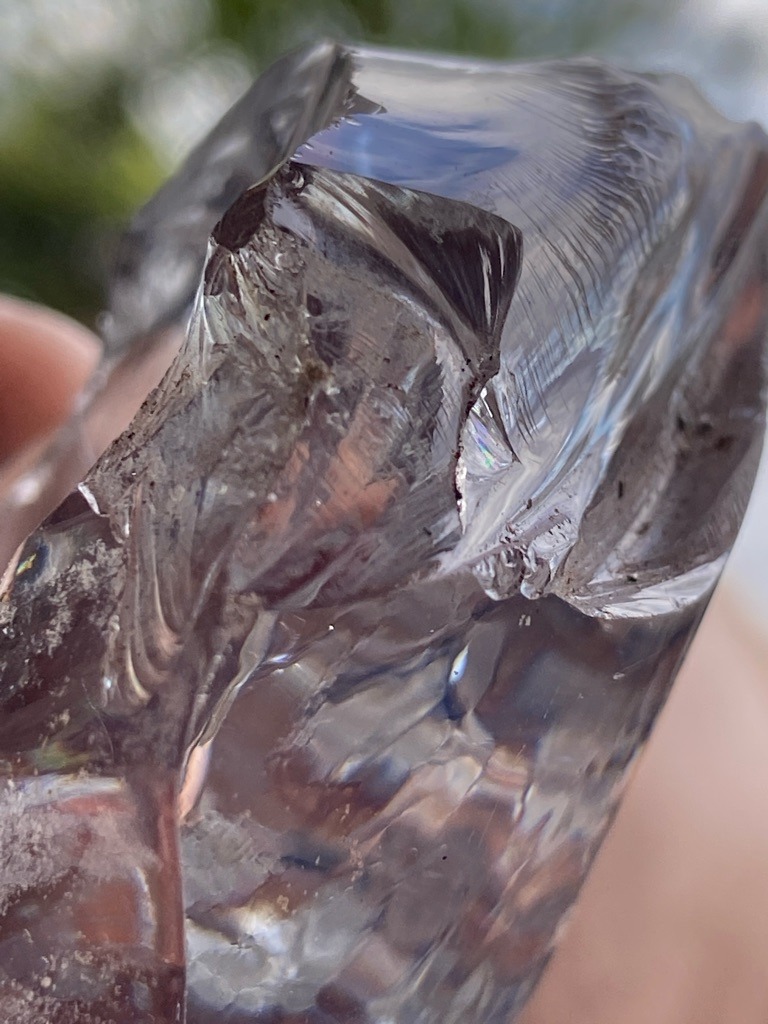
Not a diamond; this specimen exhibits clear conchoidal fracture patterns, curved striations, and lack of crystal cleavage characteristic of glass, quartz, or slag, not a crystalline diamond.
Not a diamond; this specimen exhibits clear conchoidal fracture patterns, curved striations, and lack of crystal cleavage characteristic of glass, quartz, or slag, not a crystalline diamond. · Raw, unpolished, amorphous crystal or slag fragment with no standard cut shape.
Not applicable; raw unstructured material with no faceted cut. Cut
Carat
Exceeds standard gem sizes due to raw chunk nature, visually estimated over 50+ carats if measured in gemstone equivalent weight.
Color
Colorless to smoky greyish-tinted, irregular saturation.
Clarity
Low clarity due to numerous internal fractures, flow lines, and trapped bubbles or impurities.
Shape
Raw, unpolished, amorphous crystal or slag fragment with no standard cut shape.
Overall Assessment
The specimen pictured is definitively not a diamond. The curved conchoidal fracture patterns, glassy luster, and lack of octahedral or cubic crystal habit strongly suggest it is a piece of industrial glass, slag, or quartz rather than carbon-based diamond rough.
Cut Quality
Not applicable; raw unstructured material with no faceted cut.
Brilliance
Vitreous and glass-like reflection, lacking the high refractive index and dispersion of a genuine diamond.
Fire
Minimal dispersion, far below the flash of a diamond due to lower refractive index.
Scintillation
Poor scintillation due to lack of precision facets to reflect and refract light dynamically.
Proportions
Not applicable as it is an uncut, raw specimen lacking standard pavilion, crown, or table proportions.
Symmetry
Asymmetrical, completely natural or randomly fractured form.
Polish
Unpolished, rough fracture surfaces with natural vitreous luster.
Fluorescence
Indeterminate without UV testing, likely none or inert.
Inclusions
Conchoidal ripples, internal stress fractures, potential gas bubbles, and foreign particulate matter.
Blemishes
Surface chips, rough edges, abrasion marks, and uneven fracture planes.
Origin
Likely man-made industrial slag, decorative glass, or natural quartz/obsidian rather than geological diamond rough.
Treatment Detection
No gemstone enhancements detected; physical properties indicate base amorphous material.
Estimated Value
Nominal decorative or collector value as a mineral specimen or glass piece (under $10).
Certification Estimate
Not eligible for certification by major gemological laboratories (GIA, AGS, IGI) as a diamond; would be identified as synthetic glass, slag, or quartz crystal.
Investment Potential
Zero investment value as a gemstone.
Similar Diamonds
None, as this object is visually inconsistent with diamond rough in luster, cleavage, and crystal habit.
Setting Suggestions
Not suitable for fine jewelry settings due to softness, fragility, and lack of diamond status.
Care & Maintenance
Handle with care to avoid chipping sharp edges; clean with mild soap and water if needed.
Interesting Facts
The distinct curved lines visible on the surface are conchoidal fractures, a classic diagnostic feature of amorphous materials like glass or quartz, immediately distinguishing it from diamond which fractures along specific crystallographic planes.