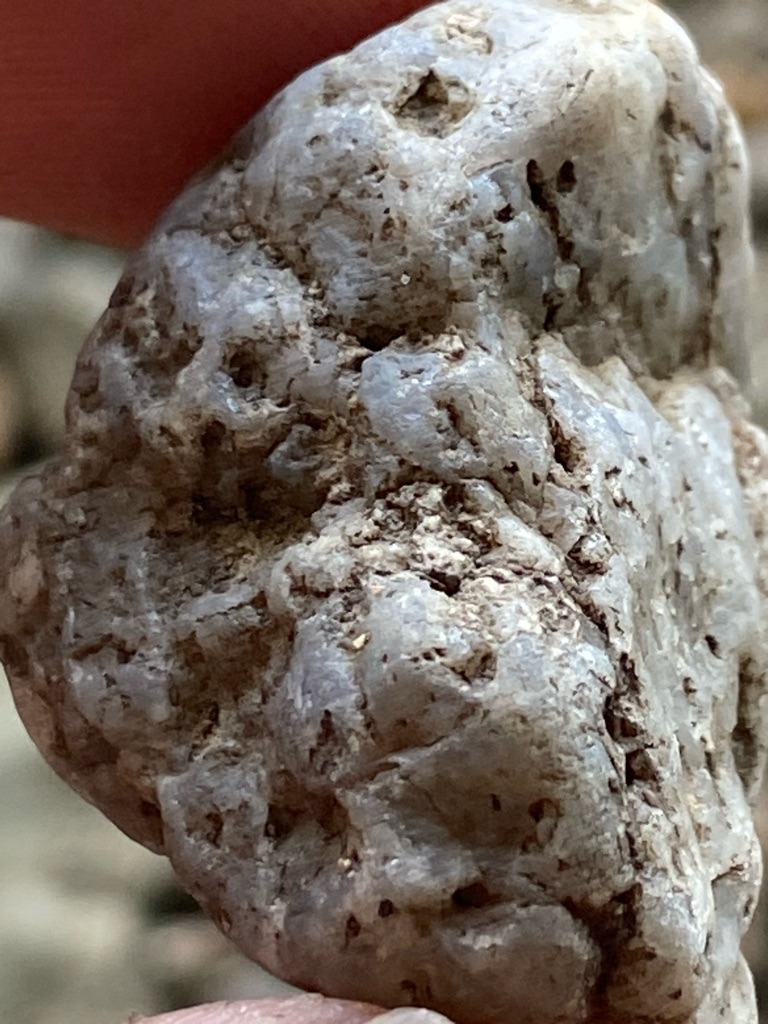
Natural rough stone, highly likely to be quartz/chalcedony or potentially unpolished rough diamond crystal matrix, but visually consistent with an alluvial rough quartz pebble given the weathered matrix and lack of octahedral crystal faces.
Natural rough stone, highly likely to be quartz/chalcedony or potentially unpolished rough diamond crystal matrix, but visually consistent with an alluvial rough quartz pebble given the weathered matrix and lack of octahedral crystal faces. · Rough, uncut, natural pebble form (unshaped/raw)
Not Applicable (Rough, uncut specimen) Cut
Carat
Estimated 15-25 carats based on visual scale in hand, though unpolished weight requires direct scale measurement
Color
Off-white to translucent greyish-white (rough matrix appearance)
Clarity
I3 (Heavy inclusions, internal fractures, and opaque rough matrix)
Shape
Rough, uncut, natural pebble form (unshaped/raw)
Overall Assessment
The specimen shown is a raw, weathered, and unpolished natural stone (most likely a mineral pebble such as quartz or chalcedony rather than a gem-quality diamond). Professional gemological testing (such as thermal conductivity or Raman spectroscopy) is required to definitively rule out industrial diamond rough.
Cut Quality
Not Applicable (Rough, uncut specimen)
Brilliance
Poor to None in current rough, unpolished state
Fire
None visible in current unfaceted, rough condition
Scintillation
None due to lack of polished facets
Proportions
Not Applicable for rough stones
Symmetry
Asymmetrical (Natural raw formation)
Polish
Unpolished (Natural rough texture with weathering)
Fluorescence
Unknown (Requires UV testing)
Inclusions
Numerous internal fractures, feather inclusions, mineral stains, and opaque patches throughout the matrix
Blemishes
Natural surface pitting, rough indentations, weathering marks, and adhered matrix material
Origin
Alluvial deposit, riverbed, or secondary gravel deposit indicated by the rounded, weathered exterior.
Treatment Detection
No treatments detected; appears entirely natural and untreated.
Estimated Value
Nominal mineral specimen value ($10 - $50) if quartz/chalcedony; significantly higher only if verified as a rare rough diamond by professional testing.
Certification Estimate
Not typically certified by major gemological labs (GIA/AGS) unless tested to confirm rare diamond rough; more commonly evaluated locally by mineralogists.
Investment Potential
Low as a gemstone investment unless authenticated as a rare, high-quality gem-grade rough diamond.
Similar Diamonds
Comparable to industrial-grade rough diamond crystal specimens or standard alluvial quartz pebbles.
Setting Suggestions
Wire-wrapped pendant setting to showcase the natural raw organic aesthetic without cutting.
Care & Maintenance
Clean gently with warm soapy water and a soft brush; avoid harsh chemicals or ultrasonic cleaners due to internal fractures.
Interesting Facts
Alluvial rough stones often travel miles down rivers from their primary kimberlite or geological source pipes, becoming naturally tumbled and smoothed over centuries.