Natural Diamond (Rough)
Natural Diamond (Rough) · Rough / Uncut
Not Applicable (Rough specimen) Cut
Carat
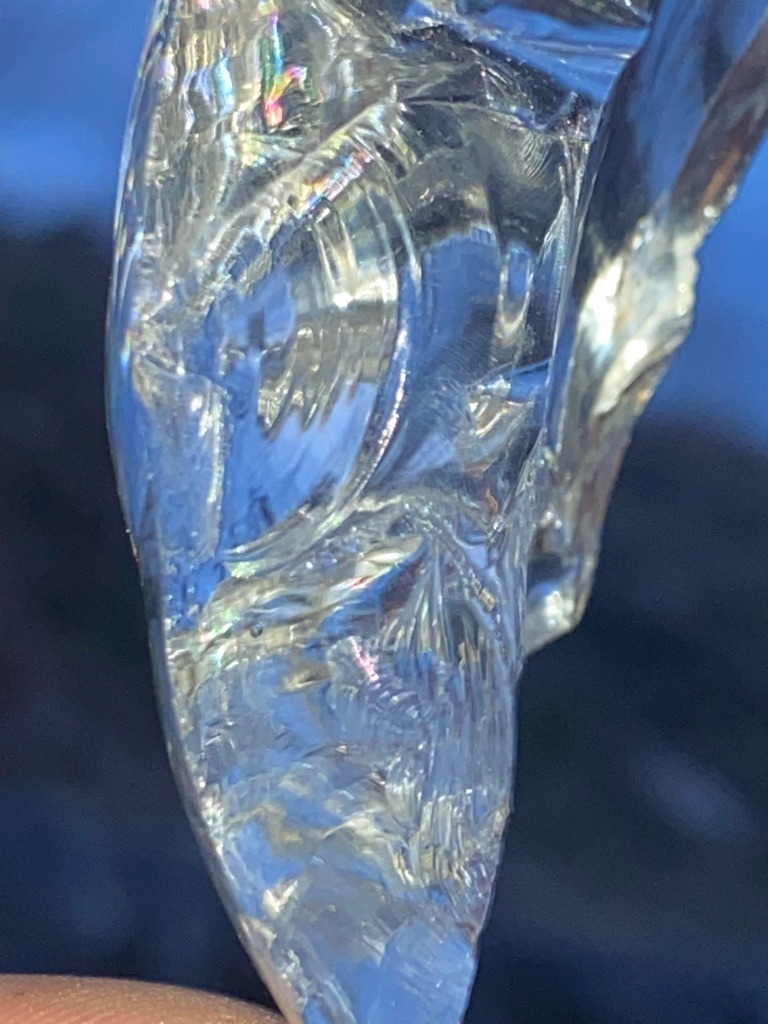
Estimated 2.5 - 4.0 carats based on visual scale against finger
Color
G-H (Near Colorless) consistent with rough specimen observation
Clarity
Translucent to Semi-Transparent (Internal fractures visible)
Shape
Rough / Uncut
Overall Assessment
A high-quality piece of natural diamond rough with significant internal characteristics. While not a gem-quality flawless specimen, it possesses the characteristic adamantine luster and light dispersion of a natural diamond crystal.
Cut Quality
Not Applicable (Rough specimen)
Brilliance
Low (Requires faceting to maximize internal reflection)
Fire
Moderate spectral flashes visible through natural surface windows
Scintillation
Low (Diffused due to lack of geometric facets)
Proportions
N/A (Unfaceted)
Symmetry
Poor (Natural irregular rough shape)
Polish
N/A (Natural matte and conchoidal surfaces)
Fluorescence
Unable to determine without UV light source
Inclusions
Prominent internal feathering, cleavage planes, and crystal distortions
Blemishes
Natural trigons or growth marks, surface abrasions, and conchoidal fractures
Origin
Likely African (e.g., Botswana or DRC) or Canadian based on morphology
Treatment Detection
None detected; appears to be an untreated natural specimen
Estimated Value
$1,500 - $3,500 depending on yield potential after cutting
Certification Estimate
GIA Rough Diamond Grading Report (Estimated G-H Color, Included Clarity)
Investment Potential
Moderate; value depends heavily on the potential cut result and polished yield
Similar Diamonds
Natural unpolished octahedral or macle diamond crystals
Setting Suggestions
Best suited for a bespoke 'rough' or 'raw' jewelry setting or as a collector's specimen
Care & Maintenance
Avoid high heat and ultrasonic cleaners due to visible internal fractures/feathering
Interesting Facts
Rough diamonds often have 'trigons,' which are small triangular growth marks on the surface that indicate a natural origin.