Natural or Lab-Grown Diamond
Natural or Lab-Grown Diamond · Radiant or Cushion Hybrid (Modified Brilliant)
Good to Very Good Cut
Carat
1.00 - 1.25 Carats (Estimated)
Color
G-H (Near Colorless)
Clarity
VS1 - VS2 (Very Slightly Included)
Shape
Radiant or Cushion Hybrid (Modified Brilliant)
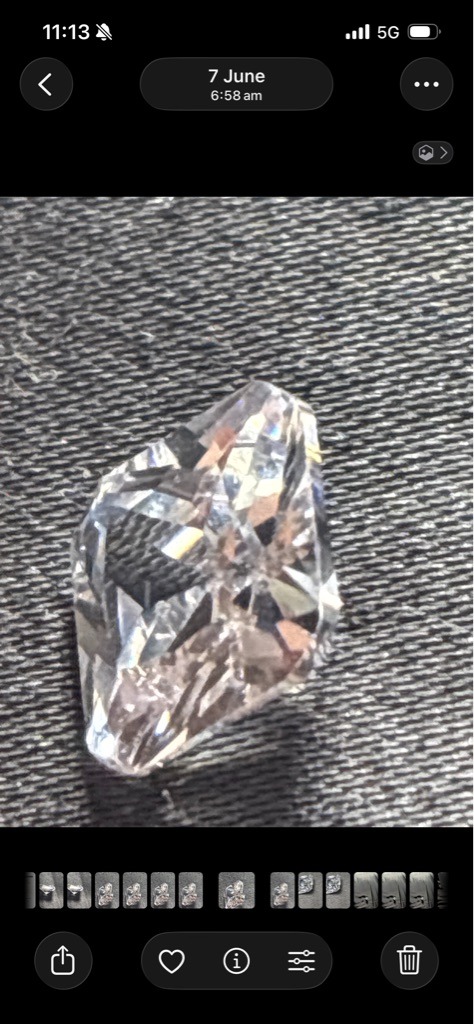
Overall Assessment
The stone appears to be a high-quality brilliant-cut diamond with a pleasing face-up appearance and significant 'fire' and scintillation. Determination of natural vs. lab-grown origin requires laboratory testing.
Cut Quality
Good to Very Good
Brilliance
Moderate; some light leakage observed due to photograph angle and cut depth.
Fire
Visible spectral dispersion on the right pavilion facets.
Scintillation
Crushed-ice style scintillation common in modified radiant cuts.
Proportions
Moderate to deep crown with a slightly uneven table surface reflected in the image.
Symmetry
Good
Polish
Very Good
Fluorescence
None visible under current lighting
Inclusions
Crystals or needles potentially visible consistent with VS range under magnification.
Blemishes
Surface dust or minor abrasions visible on the crown facets.
Origin
Unknown; lack of growth strain patterns or laser inscriptions makes source identification impossible via photo.
Treatment Detection
No obvious signs of HPHT or fracture filling visible.
Estimated Value
$3,500 - $6,500 (Natural) or $400 - $800 (Lab-Grown)
Certification Estimate
GIA or IGI; Estimated VS2, H color.
Investment Potential
Low to Moderate for consumer-grade white diamonds; resale value generally holds best in GIA-certified naturals.
Similar Diamonds
Modified Radiant/Cushion brilliants of similar weight.
Setting Suggestions
A four-prong solitaire in Platinum or 18k White Gold to enhance brightness.
Care & Maintenance
Clean regularly with warm soapy water and a soft brush to maintain light performance.
Interesting Facts
Radiant cuts were the first to have a brilliant-cut facet pattern applied to both the crown and pavilion.